
Why Technology Cannot Fix Broken Experience Design: A Strategic Guide for CX Leaders

As a Global CX services company, through decades of focusing only on supporting CX-oriented industries, such as e-commerce, retail, healthcare, insurance, banking, we are the force behind customer-facing…
View full bio →In the modern enterprise customer service environment, data is the primary currency. Every operation relies on a complex architecture of real-time monitoring and predictive analytics. For many leaders, the health of the organization is reflected in the bright colors of a digital dashboard. When the bars are green and the trends move upward, leadership feels a sense of confidence. However, at ApexCX, we believe true success is rooted in robust Experience Design rather than just technical implementation.
At ApexCX, we have found that this confidence is often a mirage. We consistently see a recurring pattern. Organizations spend millions on top-tier technology only to find that customer effort scores remain stagnant. Frontline turnover stays high.
The reality that software vendors often ignore is simple. Technology and Experience Design are not interchangeable. Technology does not fix Experience Design. It reveals it. When organizations use technology to solve systemic design flaws, they do not solve the problem. They simply scale the friction.
The Multiplier Effect: How Technology Impacts Experience Design
To understand why technology fails as a standalone fix, one must look at its function as a force multiplier. Technology is a tool for taking a defined set of instructions and executing them with efficiency. This is beneficial when the instructions are clear and the underlying design is sound. It is catastrophic when they are not.
Customer journeys are often littered with unnecessary hurdles. These obstacles are not always intentional. Sometimes they are the byproduct of rapid growth or organizational silos. A policy change in one department creates a technical debt in another. Over time, redundant identity verifications and fragmented handoffs become the standard operating procedure.
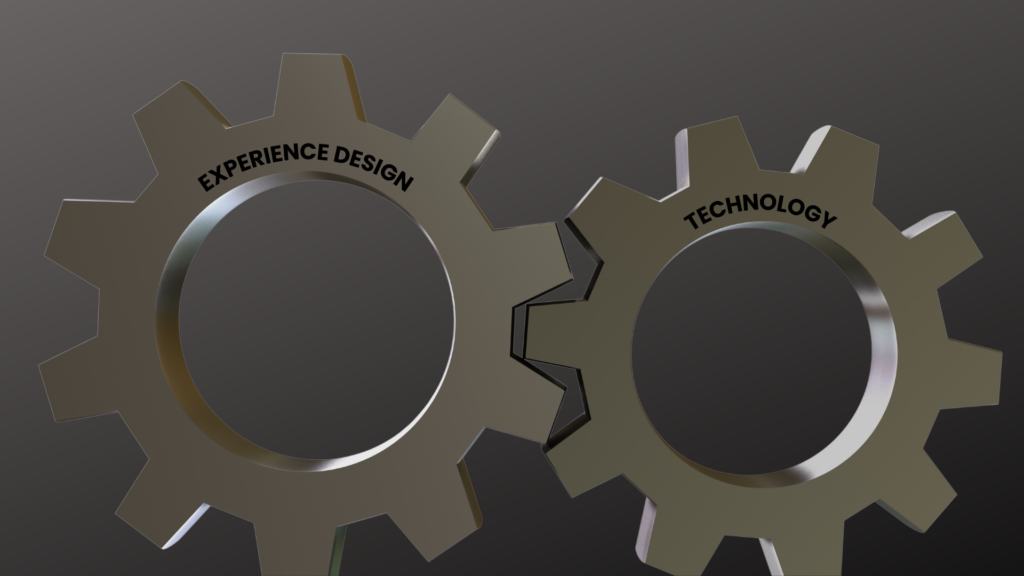
Experience Design and Technology are vital, interlocking gears in the same machine.
Automation ensures these hurdles are encountered more frequently. The human empathy that usually smooths over these gaps is removed. Instead of a slow, manual frustration, the customer experience becomes a fast, automated frustration. The experience has not improved. It has only been digitized.
Industry data supports this. A significant majority of digital transformation projects fail to meet their original ROI targets because they prioritize the tool over the task. We call this the Scaling of Friction.
The Central Trap: Managing the Metric, Ignoring the Work
The disconnect often begins at the operational leadership level. Managers look at Average Handle Time and decide that the solution is a new AI chatbot to deflect calls. They look at First Contact Resolution and decide they need a better platform to track tickets.
At ApexCX, we challenge this perspective. We look beyond the metric to the Design of the Work. You can read more about our philosophy on Metric Audits to see how we bridge this gap.
If your agents have high handle times, you must ask why. Is it because they lack a fast interface? Or is it because your policy requires them to navigate five different legacy databases just to confirm a shipping address? If your resolution rates are low, you must evaluate the cause. Is it because the software is old? Or is it because your frontline agents lack the authority to issue a small credit without a supervisor’s digital signature?
New software cannot fix a lack of trust. No AI can resolve a policy that was built to protect the company from the customer.
The ApexCX Perspective: Aligning Tech with Experience Design
A common mistake is treating technology selection as a purely technical project. IT picks the tool based on integration capabilities. Operations defines the process based on historical constraints. By the time these two streams meet, the experience is already compromised. The design is limited by the standard features of the tool. The tool is burdened by the complexity of trying to automate broken workflows.
ApexCX advocates for a Tandem Design approach. The most successful operators do not wait until the implementation phase to think about Experience Design. The true strategic pivot point happens during the Selection Phase. Leaders must perform a radical audit of the work they are asking their people to do before a single contract is signed.
Instead of asking how to move a current process to a new tool, the question must be different. Why does this process exist in the first place? What tool actually enables a better one?
An implementation is a permission slip to kill legacy habits. It is the best time to simplify decision flows and remove unnecessary layers of approval. If you simply digitize old habits with new tools, you are wasting your investment. You are buying the future to subsidize the past. For a deeper look at this concept, check out Harvard Business Review’s research on digital transformation.
The Human Element: Frontline Experience Design
Technology implementation is a psychological challenge. Marketing promises suggest that a seamless future will bring relief to the frontline. In reality, new software is often met with resentment.
Frontline agents are often comfortable with the tools they know. This is true even if those tools are clunky. They have developed workarounds to survive within a broken design. A new tool threatens that survival mechanism. It does not necessarily fix the underlying policy flaws that made the workarounds necessary.
At ApexCX, we integrate Change Management into the heart of our Experience Design process. The frontline must understand why the work is being redesigned. Without this understanding, the most expensive software will sit idle. Users might even try to force the new tool to act like the old one.
Ambiguity: The Enemy of Automation
Institutional ambiguity is a frequent barrier to a successful tech rollout. Automation requires absolute clarity. It needs to know exactly what happens at every fork in the road.
Your organization might rely on agent gut feeling to navigate complex issues because your policies are vague. If so, you are not ready for automation. Technology cannot resolve ambiguity in intent. If the company is not clear on whether an interaction should prioritize retention or cost savings, the software will fluctuate between the two. This creates a jagged experience for the customer and a frustrating environment for the employee.
The path to resolution must be clear enough for a person to follow consistently. If it is not, it is not clear enough for software to handle.
The ApexCX Solution: Optimizing Your Experience Design
ApexCX provides a structured methodology to ensure your technology strategy and your Experience Design are in alignment. Explore our consulting services to learn more.
- Audit the Analog Friction: We identify the Invisible Hurdles. We look for the number of applications an agent must juggle to solve one problem. We look for the cheat sheets taped to monitors. These are the indicators of design debt.
- Map Intent to Authority: We identify where your policies are creating bottlenecks. If your policy requires a manager’s manual override, the technology is irrelevant. We help you align your authority levels with the capabilities of your platform.
- Selection-Phase Redesign: We work with your teams during the selection process. We help you define the best path for your customer journey first. Then we help you evaluate which technology stack can actually support that path.
- Continuous Design Evolution: Your design must adapt as your customers change. We help you build an internal Design Council. This group monitors the health of the work rather than just the health of the metrics.
Excellence is a Choice, Not a Feature
The goal of a CX leader should not be to have the most technology. The goal is to have the most effective experience. When your design is sound, the technology disappears into the background. The customer does not remark on your AI interface. They remark on the fact that their problem was solved without effort.
Stop looking for the magic software that will save your CX. Start by looking at the work you are asking your people to do. Focus on the fundamentals of Experience Design. Fix the design. Empower the person. Use technology to make that excellence happen at scale.